Home › Industrial and Heavy-Duty Asphalt Paving
Handle heavy loads with confidence using industrial asphalt paving in Boise, ID. We design and build thick, reinforced asphalt sections for truck yards, loading docks, and warehouse traffic areas. Our team considers subgrade strength, base depth, and turning movements for long term performance. Request an engineered heavy duty paving plan and quote today.
Precision Asphalt Boise provides professional industrial asphalt paving throughout Boise, ID, ID and the surrounding area. Our licensed, insured crew delivers safe, clean, on-time work with a free estimate before anything begins. Call (208) 783-3122 or request your free quote.
Industrial Asphalt Paving Built for Boise Workloads
Industrial asphalt paving is different from a basic parking lot. The traffic is heavier, the loads are concentrated, and the consequences of failure are more serious. At Precision Asphalt Boise, we design and install heavy-duty asphalt surfaces that hold up to forklifts, semi-trailers, fuel tankers, and constant turning movement common at facilities around Boise, Nampa, and Meridian.
When we look at an industrial site, we start with how the pavement will actually be used. We map out truck paths, turning radiuses, loading dock approaches, trash enclosure pads, and storage areas for pallets or containers. The asphalt mix, thickness, and base support for a truck dock in Boise’s warehouse district will not be the same as an access drive for employee vehicles. We break the site into zones and engineer each one for the loads it will endure.
Boise’s freeze-thaw cycles, occasional temperature swings, and irrigation overspray from nearby landscaping all affect industrial pavements. We factor in drainage patterns, local soils, and where meltwater tends to sit in winter. For many sites in the Boise area, that means overbuilding the base in key spots and using heavier-duty asphalt mixes with higher quality aggregate and more asphalt binder, so the surface is less prone to ruts and shoving under wheel paths.
Precision Asphalt Boise focuses on long-term performance, not just getting a black surface down. That often means recommending thicker sections at truck scales, fuel islands, and dumpster pads, or adding concrete reinforcement in very high stress spots where asphalt alone is not the smartest choice. We walk the property with you, explain why each area needs a particular design, and give you options that match your budget and risk tolerance.
How Our Heavy-Duty Asphalt Paving Process Works
Every industrial asphalt paving job we handle in Boise follows a structured process so there are no surprises and the pavement performs as intended.
1. Site evaluation and core samples: On existing facilities, we often take core samples or test pits to find out what is under your current pavement. We look for soft or saturated subgrade, undersized base rock, and old patches. This tells us whether we can overlay or need to remove and rebuild. In some Boise industrial areas along the river, we see silty soils that need additional stabilization.
2. Design and thickness selection: We size pavement sections using anticipated loads, traffic counts, and Boise’s climate. For example, a typical heavy truck lane might get 6 to 8 inches of hot mix asphalt over 8 to 12 inches of compacted base, while forklift yards or container storage might require even heavier sections. We may specify different designs for interior fire lanes, dock aprons, and employee parking, all on the same project.
3. Grading and drainage shaping: Before any asphalt is placed, our crews shape the subgrade and base to create positive drainage to inlets or swales. Ponding is the enemy of industrial pavements, especially during Boise winters when standing water freezes and widens small cracks. We check slopes with laser levels and adjust grades so water does not sit in wheel paths or at dock doors.
4. Base installation and compaction: We import and place crushed, angular base rock that locks together when compacted. Every lift is compacted with vibratory rollers to a target density. On weaker native soils, we may add geotextile or geogrid reinforcement to prevent pumping and settlement under truck traffic.
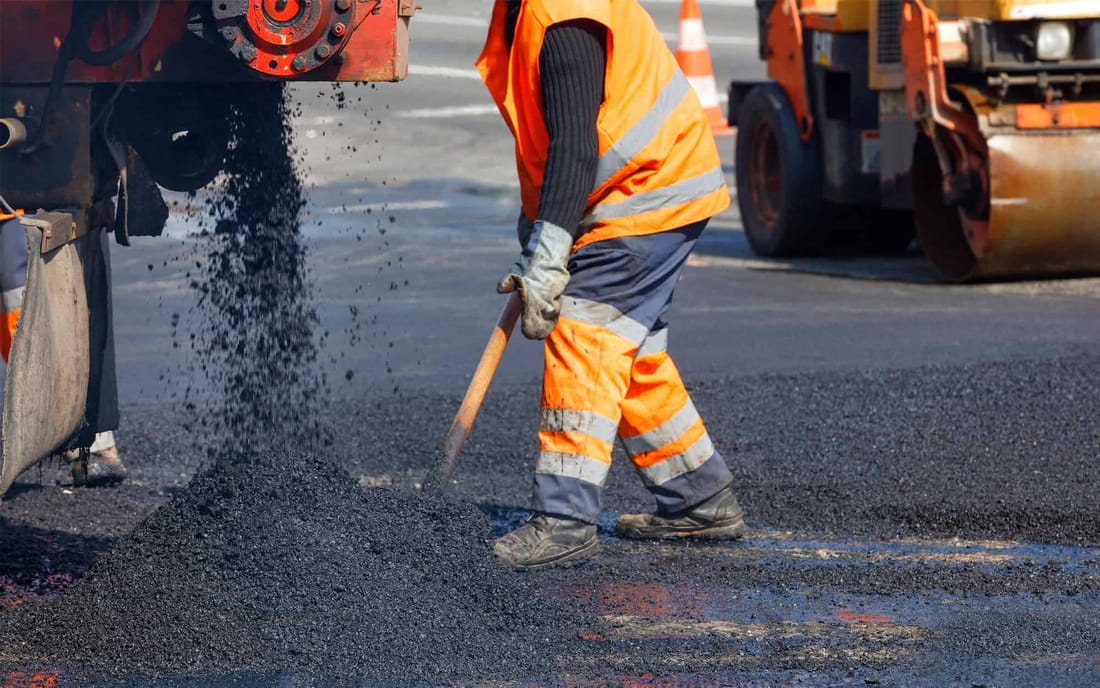
5. Asphalt placement and compaction: For heavy-duty work we typically use mixes with higher asphalt content and a well graded aggregate blend. Asphalt is placed with a paver to maintain consistent depth, then compacted in multiple passes while it is still at the proper temperature. We monitor joint quality and density, since weak joints are where industrial pavements often fail first.
6. Final detailing: We saw-cut transitions to existing concrete or asphalt, adjust manholes, and tie in to loading dock slabs so there are no trip edges or weak feathered joints. Striping for truck routes and dock numbering is laid out to match how your site operates. If needed, we install high stress surface treatments at turning areas to cut down on rutting and scuffing.
Material Choices and Design Options for Industrial Sites
Industrial asphalt paving is not one size fits all. Precision Asphalt Boise walks you through material and design choices that fit your facility’s operations and Boise conditions.
Asphalt mix types: For heavy truck and forklift traffic we often recommend mixes with larger aggregate and higher stone-on-stone contact. These resist rutting and deformation under slow, heavy loads. In some areas that see fuel drips or chemical exposure, we may suggest a dense-graded mix with improved binder performance to better tolerate spills, paired with a maintenance plan that includes prompt cleanup.
Layered pavement sections: Many Boise facilities benefit from a multi-layer approach. A thicker base course provides structural support, then a slightly finer surface course provides smoothness and better sealing. In very high wear zones like entrance aprons and sharp turns, we sometimes specify an extra heavy duty surface layer that can be milled and replaced later without disturbing the structural base.
Hybrid designs with concrete: For dumpster pads, scale platforms, or high impact loading zones, it can make sense to combine concrete and asphalt. We might pour a concrete pad where the highest stresses occur, then tie that into surrounding heavy-duty asphalt that handles general traffic. This balanced approach often costs less than full-depth concrete everywhere, but still addresses your worst stress points.
Drainage and runoff control: Boise businesses are increasingly attentive to runoff and site cleanliness. We can incorporate valley gutters, concrete swales, and trench drains in front of dock doors to keep surface water out of loading areas. In some cases we regrade around catch basins or install new structures so the asphalt is not constantly under water during spring thaws or summer storms.
Future-proofing: If you expect heavier traffic in the future, like moving from box trucks to full semi-trailers, we can design pavements with this in mind. That may mean oversizing certain sections or leaving room in the design so you can easily add an extra asphalt lift later instead of starting over.
What Drives Cost and How to Control It
Heavy-duty asphalt paving for industrial use is a significant investment, and understanding what drives cost helps you plan and avoid unpleasant surprises.
Existing conditions: In Boise, one of the biggest variables is what is already on the ground. If your current pavement is thin with a poor base, or if the subgrade has been saturated from irrigation leaks or poor drainage, more excavation and base replacement will be required. This increases trucking and material costs. Precision Asphalt Boise always explains which areas can be salvaged with patching and overlay and which sections are too risky to reuse.
Section thickness and reinforcement: Heavier sections cost more, but cutting corners here is what leads to rutting and structural failure. We show you the cost difference between, for example, a 5 inch versus 7 inch asphalt section, and where each is appropriate. If your traffic is concentrated in a few lanes, we might suggest overbuilding those lanes and using a lighter section elsewhere to keep the overall budget in line.
Access and phasing: Many Boise facilities need to stay in operation while paving is done. Working in tight time windows, night shifts, or multiple small phases can add cost because of extra mobilizations and traffic control. We help you weigh those costs against the revenue impact of shutting down an area. A well planned phasing plan can often reduce after-hours work while still keeping your operation functional.
Material choices and fuel markets: Asphalt pricing in the Boise area is affected by oil markets and seasonal demand. Very specialized mixes or small quantities can cost more per ton. When possible, we suggest scheduling larger projects outside the busiest paving months or grouping related work so plant and trucking costs are more efficient.
Long-term cost control: Sometimes the cheapest initial option is not the best value. For example, if we know a dock area will need frequent resurfacing due to tight turning trucks, we might recommend a thicker base and a surface course designed to be milled and replaced every 10 to 15 years. That minimizes future disruption and costs less in the long run than frequent patching that never really fixes the problem.
Common Industrial Pavement Problems in Boise and How We Prevent Them
Industrial pavements around Boise face a specific set of problems that differ from general commercial lots. Precision Asphalt Boise designs and builds with these in mind so you see fewer failures and less downtime.
Rutting and shoving in wheel paths: Slow moving, fully loaded trucks and forklifts can shove asphalt sideways, especially in hot weather. This often shows up at scale approaches, gate entrances, or tight turn areas. We combat this by using rut resistant mixes, thicker sections, and sometimes adding reinforcement grids under the asphalt in problem zones.
Edge breaking and shoulder failures: In many local industrial parks, truck drivers run their wheels right at the outside edge of the pavement. If that edge is not well supported, it breaks off and the pavement unravels inward. We address this with proper base width beyond the asphalt edge, or by installing concrete ribbon edges or curbs in critical areas.
Cracking from poor subgrade: Boise’s varied soils and irrigation use can create soft spots that lead to cracking and settlement. Before paving, we proof roll the base to locate weak areas, then undercut and rebuild those zones. Sometimes we incorporate geotextile fabrics or cement treatment in the subgrade where soils are particularly weak.
Water intrusion and freeze-thaw damage: If water gets into the base through cracks or poor joints and then freezes, small problems quickly become big ones. We focus on tight joints, adequate slopes, and proper sealing of saw cuts and transitions. For facilities that use a lot of washdown water, we pay extra attention to directing that water into controlled drains instead of letting it run along joints.
Maintenance planning: Even heavy-duty industrial asphalt needs care. After installation, we can provide a simple maintenance schedule, including when to consider crack sealing, sealcoating in lighter traffic areas, or local patching. By catching issues early, you avoid major reconstruction and keep your Boise operation moving without emergency shutdowns.